
Why Do I Still Feel Stuck? The 5 Phases of Real Change in Therapy

You know real change is happening when it shows up outside the therapy room, not just inside it: fewer thought loops, less bracing before hard conversations, sleep that isn’t interrupted by the same replay. In my work, I’ve come to recognize five phases that often accompany deeper therapeutic change.
Do you still find yourself saying nothing in a conversation where it would benefit you to speak up? Rereading a message long after you sent it? Lying awake at 2am with the same thought loop?
If you do, it doesn’t mean you aren’t trying. It doesn’t mean therapy hasn’t helped. It may mean something deeper hasn’t had the chance to move yet.
At some point, you start to wonder if this is as good as it gets.
It can be better.
Why Isn’t Therapy Working for Me? I Feel Stuck.
Most people who find themselves here have already done real work. They’ve tried things like CBT, mindfulness, and affirmations. Some have gone deeper into trauma therapy, somatic work, IFS or inner child work, or Emotionally Focused Therapy—approaches that slow things down and work beneath the surface story.
They’ve shown up. They’ve tried. And somewhere in the process, they hit a wall that understanding alone couldn’t move.
You are reacting to what is happening now, while responding to what has not yet healed. That is how you can understand your patterns clearly, talk about them in therapy, and still find yourself caught in the middle of them before you even realize what’s happening.
Understanding why it happens matters. What’s less often explained is what it actually looks like when it starts to change.
What Real Change Actually Feels Like
After years of sitting with people in this work, I’ve noticed that change is rarely a big light bulb moment. It tends to arrive quietly, in the body and in the mind.
Someone realizes they’ve gone three days without replaying a conversation. A date on the calendar passes and they realize they got through it. They notice they are no longer clamping their jaw and are expressing their needs.
People often describe it this way:
“I actually feel happiness.”
“I am enough, and it’s okay to be me.”
“That does not define me.”
They aren’t understanding something new. They’re living differently.
The 5 Phases of Real Change in Therapy
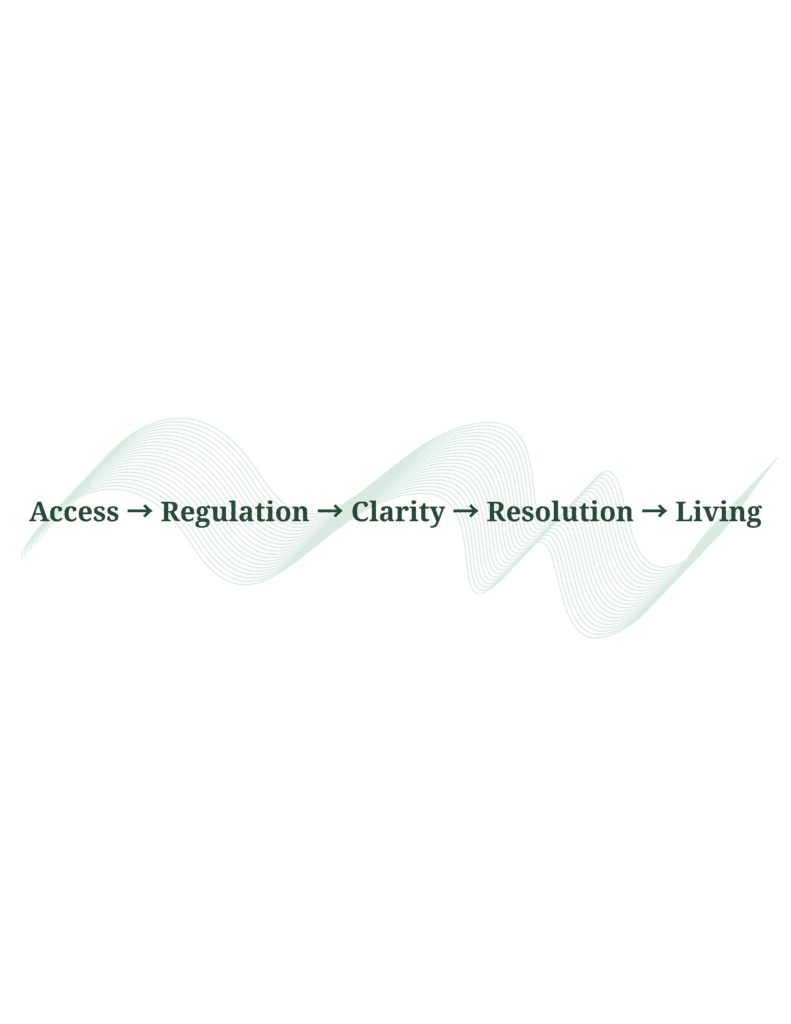
The arKardia Method™ is a framework for healing that integrates EMDR therapy, Brainspotting, and other evidence-based approaches. Over years of doing this work, I’ve come to think about and witness deeper therapeutic change in five phases: Access, Regulation, Clarity, Resolution, and Living.
1. Access: What Was Unseen Becomes Available
This is where we begin.
I may repeat a phrase you used in passing because something in it matters. I may ask a question that connects what’s happening now to something further back. I may invite you to notice what’s happening in your body right in this moment.
I’m not following a script. I’m paying attention. To your words, your history, and what’s underneath both.
People are often surprised by the questions, not because they’re difficult, but because no one has asked them quite that way before.
Something connects that hadn’t before. It might arrive as a memory, a younger version of yourself, a familiar scene. Or it might arrive in the body first. A breath that catches. A tightness in the chest.
“I didn’t realize I was still carrying that.” “That feeling isn’t just about this.”
It’s like pulling a book away from your face just enough to see the whole page. Nothing new has been added. You’re finally able to see what was already there.
2. Regulation: The Nervous System Begins to Settle
Once something becomes accessible, there’s no pressure to push through it. I simply invite you to explore whether it feels okay to stay with it a little longer.
Many of my clients learned early that what they felt was too much, needed to be hidden, or simply wasn’t safe to show. That pattern doesn’t disappear just because you’re ready to do the work.
When appropriate, I may use bilateral stimulation through sound or eye movements as part of EMDR processing, or Brainspotting as we stay with what is emerging. I stay attuned to you in the present moment, so you’re not moving through it alone and we can pay attention to what your system can tolerate.
As trust in the process grows, the body begins to learn something it may never have had the chance to learn before. I often describe it as a wave. It comes in, builds, peaks. And then it goes back out. Some waves are bigger than others. But they don’t hold you under in the same way.
At some point, something settles. You realize: “I can feel this. I’m okay.” You didn’t force it. You were able to stay with it without being overwhelmed by it.
3. Clarity: What Is Yours and What Is Not
As the nervous system settles, something begins to shift in how things feel. Not just how they are understood.
This is where the meaning of arKardia starts to show up. The head and the heart begin to move toward each other. What you’ve known intellectually starts to become something you feel as true.
We work with the beliefs formed through painful experience. “I am not enough.” “I am the problem.” “Something is wrong with me.” Clarity is where those beliefs begin to loosen their hold in mind and body, and the truth grows stronger. Not all the way yet. But the direction has changed.
Consider someone who grew up never quite feeling good enough for a parent. They’ve understood for years that their parent was struggling, was emotionally immature, was passing their own hurt down. They’ve known it in their head. But it hasn’t changed how they feel about themselves.
In this phase, something different happens. They begin to see, not just know, that they were not the issue. That what was put on them belonged to someone else’s pain, not their own worth.
You can often see it before they say a word. A deep breath arrives on its own. The chest that wanted to cave in opens instead. The shoulders rise. There is a lightness that wasn’t there before. That is what clarity can feel like in the body.
The story has changed. And that changes everything that follows.
4. Resolution: The Past No Longer Runs the Present
Clarity shifts the direction. Resolution is where the past stops running the present.
The body that used to brace or tighten when that memory surfaced is now calm. Still. What once felt difficult to bring to mind no longer pulls at you the same way.
This is not the same as time passing or forgetting. The memory remains. What changes is its charge. It no longer reaches into the present and grabs you. Healing doesn’t erase your story. It changes the role your story gets to play in your life.
Grief is a good example. Early on it can feel like it is happening all over again. A date on the calendar, a familiar place, a song. And suddenly you are right back in the hardest part of the loss. As resolution arrives, the pain softens. The loss is still real. The love is still there. But the fear of feeling it doesn’t take you over. You can think about the person and feel the closeness without being swept under by it. The closeness can begin to feel comforting rather than only painful.
For someone navigating betrayal trauma, resolution is where the questions that kept turning inward finally stop. Not because the betrayal didn’t happen. Because it no longer defines what they believe about themselves.
For some people, this also restores a sense of connection with God. Questions that once felt tangled in fear, shame, or self-blame begin to feel steadier, allowing faith to become a source of comfort rather than pressure.
5. Living: A New Way of Responding
This phase happens outside the therapy room.
You are no longer stuck, not because you are managing better or trying harder, but because what was driving the stuck is no longer there in the same way.
You speak up in the conversation. And mean it. You send the message and don’t look back.
You lie down and sleep.
These are not small things. For someone who has spent years saying nothing, replaying everything, and lying awake at 2am with the same thought loop, they are everything.
I hear this from people again and again: more happiness, less anxiety, better concentration, improved performance, more confidence. A life that has more room in it. Not because circumstances changed. Because you did.
Less bracing. Less second-guessing. You’re not trying to become someone else. You’re living with more freedom because you’re no longer operating from the same place.
What makes that possible isn’t just the approach. It’s the structure of the work itself.
Why Do I Keep Circling Back to the Same Issues in Therapy?
These phases don’t happen on a timeline you can force. But the structure of the work affects how much room they have to move.
In weekly therapy, something important can begin to open just as the session is coming to an end. There may be enough time to identify what’s there, but not always enough time to stay with it as long as the work needs.
A trauma intensive or EMDR intensive creates something different. It creates a longer, protected period for the work. Instead of stopping because the hour is over and returning to it the following week, there can be more time to follow what emerges, work through it, and integrate what changes.
Is a Therapy Intensive Right for You?
If you’ve been in therapy for a while and still feel stuck, that’s not a sign that you, or your therapist, are doing anything wrong. It may simply mean the work needs a different structure.
At arKardia Counseling in Gettysburg, Pennsylvania, I offer Focused Healing Intensives for individuals and couples. Some people come for a single concentrated day. Others spend several days in a row doing the kind of work that can be difficult to fit into a standard weekly session. Clients come from across Pennsylvania and travel from across the country. The work draws on EMDR therapy, Brainspotting, and the arKardia Method™.
The goal isn’t just to understand your story. It’s to live differently within it.
If this sounds like the work you’ve been looking for, you can learn more about Focused Healing Intensives here. Or, you may schedule a Discovery Call. That’s where we figure out together whether this is the right fit and the right time.
Frequently Asked Questions

Written by Michele Montenegro, MSW, LCSW
Michele is a faith-integrated therapist and the founder of The arKardia Method™, an approach that treats the mind, body, relationships, faith, and history as connected parts of the same story. She’s an EMDRIA Certified EMDR Therapist and Brainspotting Practitioner with a background spanning Johns Hopkins Hospital, Johns Hopkins University, Catholic Charities, and Gettysburg College. Her clients range from executives and ministry leaders to anyone quietly carrying more than they let on, and she works from the belief that lasting change starts when the head and the heart move in the same direction.