
Why Do I Doubt Myself After Being Hurt?

What Your Body Already Knows
Maybe you’ve seen it happen: a story becomes public, betrayal, assault, or something else that broke someone’s trust, and within days the questions start.
Did you notice your body react? Mine did.
A woman comes forward, or a case comes to light. Was she aware? Was she drinking? Why didn’t she stop it? They were married, does that change things?
Different names, same shape. It keeps surfacing.
Self-doubt after someone hurts you isn’t a character flaw or a sign you’re overreacting. Sometimes your body registers something before your mind has caught up to it. In my work with women who’ve carried this exact pattern, that reaction (the tight chest, the dropped stomach, the tears that don’t always make sense) is worth paying attention to, not something to automatically explain away.
Why Can’t I Trust Myself After Being Hurt
The lens that was on his behavior turns, and suddenly it’s zoomed in on hers. This is when the story stops being about what happened and starts being about her: what she did, what she didn’t do, what she “should” have seen coming. The more the conversation tilts in that direction, the less room there is to name what was actually done to her.
Over time, that doesn’t just change how people talk about stories like this. It changes how women talk to themselves. Research on sexual assault survivors has found that self-blame in the early aftermath of an assault can predict the severity of PTSD symptoms later on, and that those symptoms can, in turn, deepen the self-blame.
I’ve heard versions of this in my office from women who run companies, lead ministries, hold entire families together, women who look, from the outside, like they have it all figured out: I must have missed something. I should have seen it coming. Maybe it doesn’t even “count” as harm.
At first, it can sound like she’s just trying to make sense of things. But slowly, it stops being curiosity and turns into self-doubt. Instead of asking, “What happened to me?” she starts asking, “What’s wrong with me?”
When she starts to question herself, her internal compass starts to waver. She doesn’t automatically trust what she felt. She double-checks it against the relationship, the circumstances, the things people say “should” matter. Without realizing it, she moves further away from the simple truth she had in the moment: something was not okay.
Let me be clear about something. There is no condition that makes harm acceptable. Not alcohol. Not clothing. Not a bad mood. Not relationship status. Not marriage.
He is 100% responsible for 100% of his behavior 100% of the time.
But when questions about alcohol, clothing, mood, or marriage keep getting pulled into the center of the story, something inside her starts to shift. The more those conditions are emphasized, the easier it becomes for her to question her own right to name what happened.
Why Does My Body React Before My Mind Understands What Happened

By the time she has heard those questions enough times, out loud and in her own head, the doubt is no longer just in her thoughts. It starts to show up in her body. A stomach that drops. A throat that tightens. A chest that flutters. A wave of emotion that doesn’t fully make sense. She might find herself tearing up over something she reads and then just as quickly trying to explain it away: I don’t even know why this is affecting me like this.
It is responding to something it recognizes: the themes are familiar even when the experience isn’t the same. Vulnerability, loss of control, or trust broken in a place that was supposed to be safe.
This lines up with what the VA’s National Center for PTSD has documented: something as ordinary as a news report can act as a trauma reminder, bringing up reactions connected to a person’s own past. Sometimes that reaction comes before she’s consciously made sense of why this particular story is affecting her.
Her body doesn’t separate these things the way her mind tries to. It registers them. And when it does, it’s asking a different question than the conversation around her. Not “What did she do?” but “Am I safe?”
This is why stories like this don’t just stay on the screen. They don’t just inform. They take hold. They settle into a woman’s body and into the stories she tells herself about what “counts” as harm. And when they do so in a culture that has repeatedly taught women to question themselves, the impact goes deeper than awareness. It starts to touch something more foundational: a woman’s trust in what she feels, in what she notices, and in what she knows to be true.
How Do I Learn to Trust Myself Again After Being Hurt
Healing is not just about what happened. It’s about being able to come back to yourself and trust that your internal response is not something you need to dismiss, explain away, or override. That’s part of the work of The arKardia Method™: learning to trust your own signal again.
In the intensives I run, this is usually one of the first things we work with, not the story itself, but the body’s version of it. Long before a client can put words to what happened, her body has already been trying to tell her. Part of the work is simply learning to listen to that signal again instead of arguing with it.
If this resonates with you, here is something I want you to remember: not everything you come across is yours to carry. But when something stays with you, when your body responds before you’ve made sense of it, that doesn’t mean you’re overreacting.
Something in you is paying attention. It deserves a voice. It deserves to be heard.
You don’t have to sort through that on your own. Reaching for support is not a sign that you’re weak or overreacting; it is a way of honoring what you’ve already been carrying by yourself for a long time.
What happened to you matters. And so does your right to be safe now.
Frequently Asked Questions
If you recognized yourself in this, please reach out. I’d love to hear from you. Get in touch here.
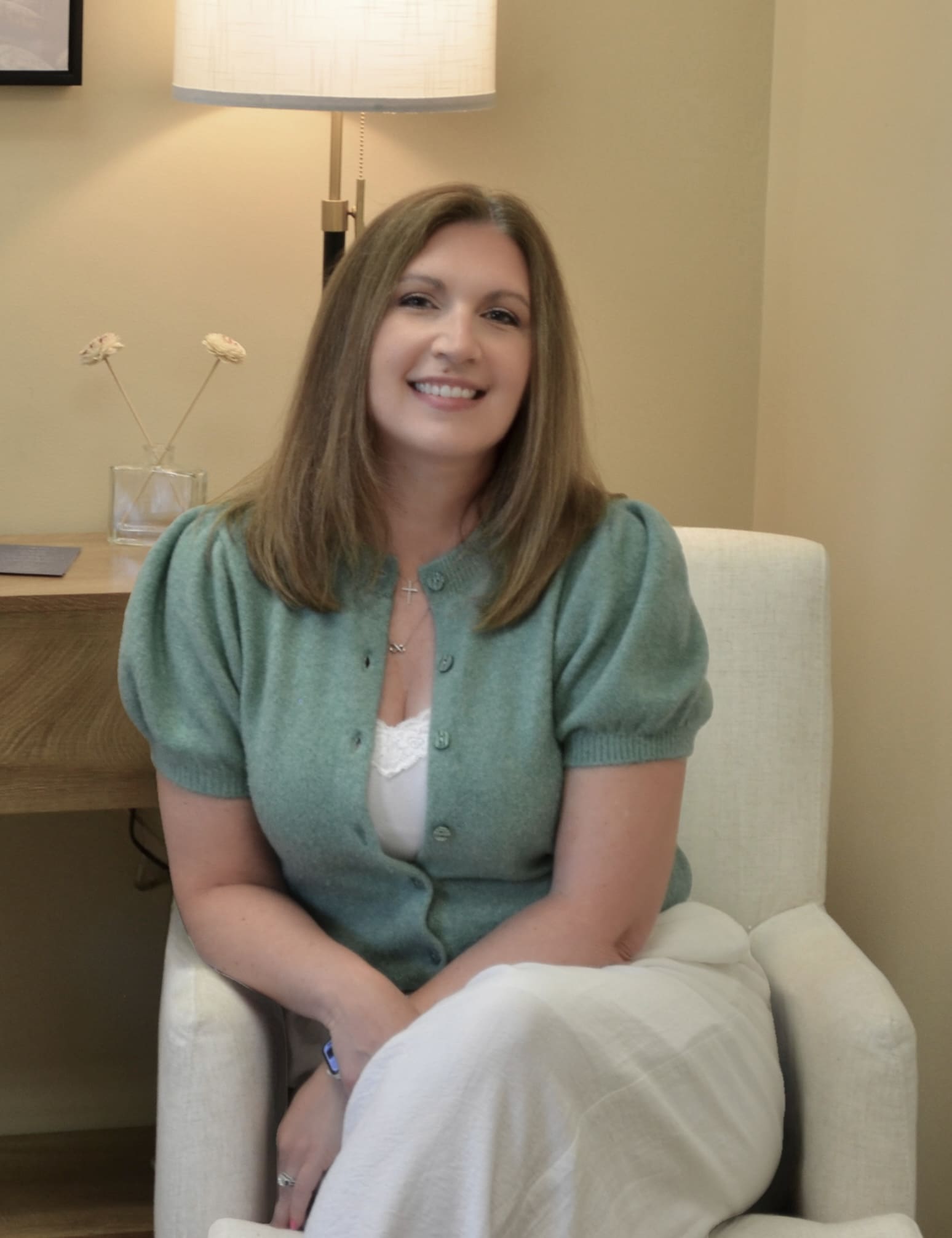
Written by Michele Montenegro, MSW, LCSW
Michele is a faith-integrated therapist and the founder of The arKardia Method™, an approach that treats the mind, body, relationships, faith, and history as connected parts of the same story. She’s an EMDRIA Certified EMDR Therapist and Brainspotting Practitioner with a background spanning Johns Hopkins Hospital, Johns Hopkins University, Catholic Charities, and Gettysburg College. Her clients range from executives and ministry leaders to anyone quietly carrying more than they let on, and she works from the belief that lasting change starts when the head and the heart move in the same direction.