The arKardia Method™️
An integrative framework for whole-person healing because healing is not one-dimensional.
Many professionals say they treat the whole person. What they often mean is that they work through one door: thoughts, or the body, or relationships. Each can help. But reaching one level without the others often explains why the same patterns keep showing up in you despite real work.
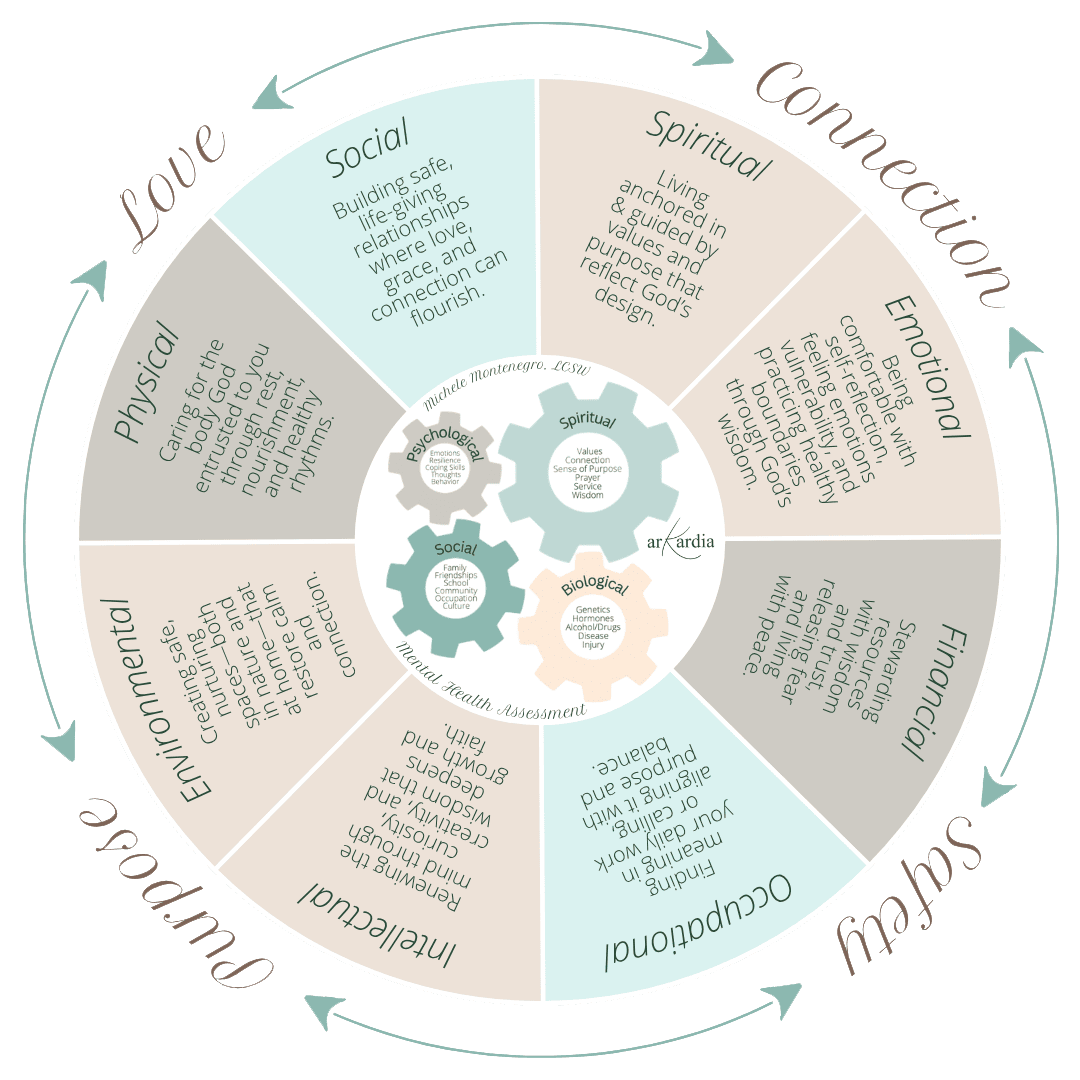
The arKardia Method™ is built around a specific framework for what whole-person healing actually requires.
Rather than beginning with a predetermined protocol, the work starts with understanding what is keeping you stuck and what is needed most. From there, the process draws from evidence-based therapies, nervous system-informed care, relational healing, and spiritual integration when desired.
At its core is the belief that people possess an innate capacity for healing and growth. While painful experiences can keep you feeling disconnected from yourself, others, and even God, they do not define you or your potential for change. When the mind, body, heart, and spirit are given the right conditions for healing, transformation becomes possible.
The Foundations
Every part matters. Every part is connected.
At the center of the framework is what I call the Biopsychosocial Core: the recognition that your biology, your psychology, your relationships, and your spiritual life are not separate systems. They shape each other constantly.
The second is the Kardia Wellness Wheel, which maps eight dimensions of wholeness: spiritual, emotional, physical, intellectual, occupational, financial, social, and environmental. It offers a way to view wellness across multiple dimensions, helping identify areas of strength, areas needing attention, and places where life may have become out of balance.
The third is the Four Universal Needs: every human longs for love, connection, safety, and purpose. When these needs are consistently nurtured, growth becomes more possible. When they are absent, threatened, or distorted, their effects often show up in how you think, how you relate, and what your body holds.
Together, these foundations create a more complete picture of who you are, what is contributing to the struggle, and what is needed to move toward healing, wholeness, and flourishing.

The work moves through stages, though rarely in a straight line.
We begin by understanding your story, your patterns, and what you’re carrying. From there, we develop awareness of what’s underneath: the beliefs, the body-based responses, and the relational dynamics that have shaped your experience.
Along the way, education is woven naturally into the process, helping you understand how past experiences, faith, and the ways you’ve learned to adapt continue shaping the way you experience life today.
As trust grows, meaningful healing becomes possible. Then the real work begins, and people often notice something shifting, not just thinking differently about their experience, but actually feeling it differently. If you want to understand what that part of the process looks like, I’ve written about it in depth here.
The arKardia Method™ works at the root of what you’re coping with.
If this is what you have been looking for, I’d welcome the conversation.