
EMDR THERAPY AND BRAINSPOTTING
Healing what words alone can’t reach.
Your body remembers things your mind has already moved past. It braces for impact long after the danger’s gone, holds tension from something it never got the chance to finish processing, keeps reacting to a version of the world that isn’t true anymore.
This work meets you there, in the part of you that doesn’t speak in sentences, without needing you to explain, understand, or perform any of it. You just show up. The rest unfolds on its own.
Your body doesn’t always know the danger has passed.
Think about the last time someone jumped out and scared you. Your body reacted before your brain had a chance to register it as your best friend. Heart racing, breath caught, muscles tightened… and only afterward did your thinking brain catch up and say, “Oh, it’s just John.”
That’s your nervous system doing exactly what it was designed to do.
The problem is that it doesn’t always know when the threat has passed. For many people, the body continues responding to something that ended long ago, or something still being navigated. You can know you’re safe and still brace for impact.
This is why talking helps us understand what happened. But not everything that keeps us stuck is stored in words.
EMDR and Brainspotting offer a different pathway for processing experiences that may not fully resolve through conversation alone.


Ways to work with me

EMDR
EMDR Therapy uses bilateral stimulation. In a session, this might look like following a moving finger with your eyes, listening to alternating tones through headphones, or holding gentle pulsers in each hand. The back-and-forth rhythm supports the brain’s natural ability to process and integrate difficult experiences.
You don’t have to relive what happened in detail. You simply notice what comes up and allow the process to unfold. The process is often simpler than people expect.
As processing occurs, the emotional intensity attached to a memory often decreases. The memory remains. What once felt true in the middle of pain may no longer feel true once the experience has been fully processed:
“I’m not enough.” → “I am enough.”
“It’s my fault.” → “I am free of blame.”
“I’m not safe.” → “I am safe now.”
EMDR Therapy does not erase the past. It helps the past stop interrupting the present.
Individual session (55 min): $175; no insurance accepted

Brainspotting
Sometimes what needs attention doesn’t arrive as a thought or a memory. It shows up as a tightness, a wave of emotion, a sudden pull inward, or a sense that something inside still isn’t settled.
These responses are often protective. They form quietly, without language, as the nervous system learns to keep functioning during moments of overwhelm or emotional unsafety. Long before we can make sense of an experience, the body is already doing its best to help us get through it.
Brainspotting listens to those signals. Using a fixed point in the visual field, and sometimes bilateral sound, it works with experiences that often live beyond words and conscious understanding. Many people notice thoughts, emotions, memories, or physical sensations emerge in ways that feel surprisingly natural.
EMDR has decades of research behind it. Brainspotting is newer… the research is still catching up, but what clients experience in the work tends to be meaningful and lasting.
There is nothing to perform and nothing to figure out. The nervous system does the work.
Individual session (55 min): $175; no insurance accepted

You can’t do it wrong.
One of the most common concerns I hear is: “What if I don’t do it right?”
You don’t need to arrive with a clear explanation or the right words. You don’t need to know why you feel the way you do or have a perfect memory.
The good news is that you can’t do it wrong. My role is to pay attention to the nuances and guide the process. Your role is simply to notice.
Sometimes I compare it to a child sifting through sand at the beach. You gently move things around and see what you find. Some discoveries are expected. Others surprise you. Healing often unfolds the same way.
It can feel counterintuitive at first. Most of us are used to trying harder, figuring things out, or searching for the right answer. This work is different.
Not sure which approach is right for you?
No two people heal in exactly the same way.
Most people arrive wondering which one they need. The honest answer is that I rarely use just one.
Part of my role is paying attention to what the moment calls for and knowing which approach to lean into. That’s not something you need to figure out before you come in. You simply show up.
We’ll figure it out together.
Before we schedule your first appointment, we’ll have a brief discovery call. I hope you’ll leave that conversation feeling like you’ve met someone you can trust and talk openly with. But therapy is personal, and not every therapist is the right fit for every person.
If, after a session or two, you don’t feel like we’re the right fit, that’s completely okay. Your needs are always more important than my feelings. I’ll never be offended, and I’ll help you find another therapist who can help you.
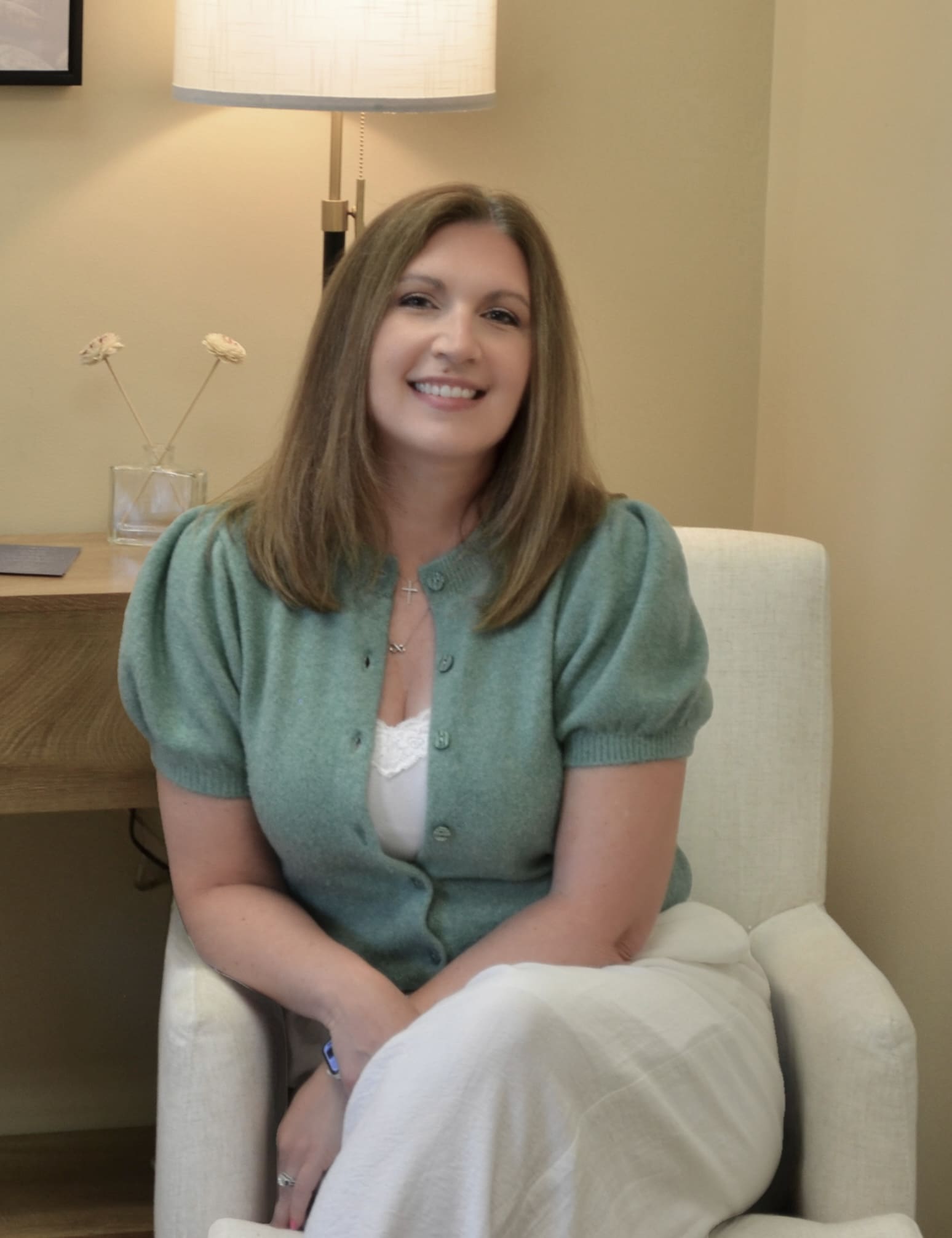
A space designed for you
Sometimes a session ends and you need a few moments to gather your thoughts, sit quietly, pray, or simply transition before stepping back into the rest of your day.
For that reason, arKardia includes a private reflection room adjacent to the therapy office. Clients are welcome to use the space before or after sessions as needed. Some spend a few moments journaling. Others pray. Some simply sit in silence.